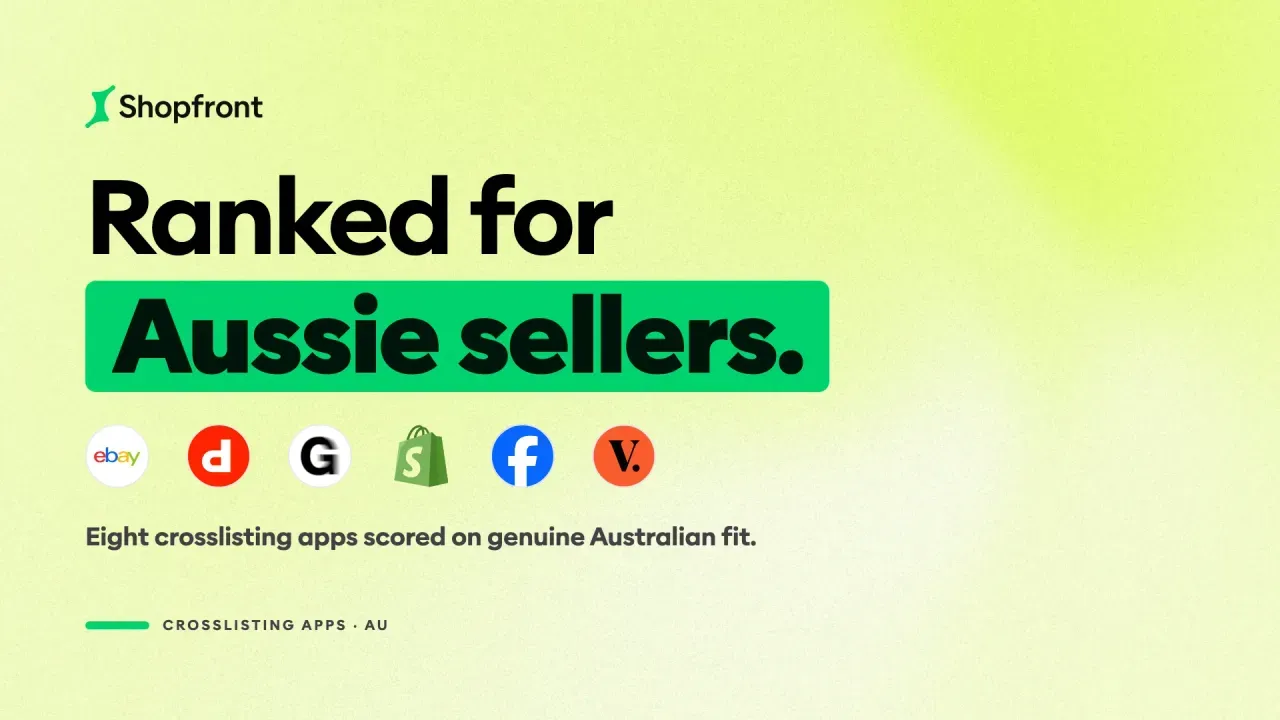

For most Australian resellers, Shopfront is the strongest crosslisting app in 2026: it’s built in Melbourne, and all six of its marketplaces — eBay, Depop, Grailed, Shopify, Facebook Marketplace and Vestiaire Collective — actually operate here. Crosslist wins on marketplace count, List Perfectly on catalogue size, and Listalong is a local option focused on eBay and Depop.
Shopfront is our product — we’ve kept the comparisons factual and sourced, but we’re not neutral.
Every competitor figure below was read from that tool’s own site on 7 August 2026, and each entry links to a fuller sourced comparison. Prices are as published on each site; Shopfront bills in USD.
The short version
| Tool | From (as published) | Marketplaces | Standout |
|---|---|---|---|
| Shopfront | $30/mo (200 active products) | 6 — all operate in Australia | AI listing generation on every plan |
| Crosslist | $29.99/mo (200 new listings) | 11+ | Widest coverage that includes Australia |
| List Perfectly | $29/mo | 10 | No listing caps on any tier |
| Listalong | 19 Australian dollars/mo | 2 — eBay ↔ Depop | Australian, with AusPost CSV export |
| Voolist | $19.99/mo (250 active listings) | 7 | Official platform APIs only |
| Vendoo | $14.99/mo (unlimited items) | 10+ | Marketplace breadth, Poshmark tools |
| Flyp | $9/mo flat | 7 | Cheapest, with a 100-day free trial |
| Nifty | $39.99/mo (crosslisting only) | 6 | Cloud automation bots |
How we ranked: marketplaces that Australians can actually sell on, what the entry price buys, whether double-sell protection is included on the plan you’d realistically pay for, and how much of the product survives the trip across the Pacific. Poshmark and Mercari don’t operate in Australia, which quietly guts several of these tools for local sellers.
1. Shopfront — best overall for Australian sellers
Shopfront lists to eBay, Depop, Grailed, Shopify, Facebook Marketplace and Vestiaire Collective — six marketplaces, and every one of them works for Australian sellers. Grailed has a growing Australian base, Vestiaire Collective has a growing Australian seller base, and Facebook Marketplace is arguably the strongest local channel in the country. Facebook has no public API, so Shopfront dispatches those listings through its Chrome extension in your own browser.
The AI listing generator builds the title, description, brand, category and price from your photos, and it’s included in every plan rather than sold as an add-on. Sale detection runs on every plan too — hourly on the $30 Pro plan, down to every 10 minutes on Premium Plus — and crosslisting and delisting are never billed per use. The team is in Melbourne, so support runs on Australian hours.
The honest gaps: Shopfront doesn’t list to Poshmark, Mercari, Etsy, Vinted or Whatnot. Plans are billed in USD, active products are capped by plan (200 on Pro, 1,000 on Premium, 3,000 on Premium Plus), and AI generations are metered per plan like everyone else’s. If Vinted is central to your plans, Crosslist covers it today and we don’t.
See pricing or how it stacks up against every rival we track.
2. Crosslist — widest coverage that includes Australia
Crosslist supports sellers in Australia alongside the US, UK and Canada, and covers 11+ marketplaces — including Vinted, which launched in Australia with zero seller fees. Auto-delisting of sold items is included on Gold and Diamond, and its mobile apps carry nearly all functionality. That’s a genuinely strong package.
The catches, per its own pricing page: plans start at $29.99 a month for 200 new listings and only the $44.99 top tier is unlimited; the AI is a separate $4.99 a month add-on metered in credits; and there’s no free trial, just a 3-day money-back guarantee that lapses once you’ve created 20 listings. Poshmark, Mercari and Whatnot pad the marketplace count but do little for Australians. No Vestiaire Collective.
Full comparison: Shopfront vs Crosslist.
3. List Perfectly — best for very large catalogues
List Perfectly puts no cap on listings on any tier — a real advantage if you’re holding thousands of items — and staffs human support every day of the year. Its marketplace list covers the Australian-relevant set (eBay, Depop, Grailed, Facebook, Vestiaire Collective) plus Poshmark, Mercari and Etsy, with Shopify and Instagram on higher tiers.
The ladder is the catch. Plans run $29, $49, $69 and $99+, AI is 25 actions a month on the entry plan, and auto-delisting — the feature that stops you selling the same jacket twice — is listed on the $99+ Pro Plus tier. Shopfront runs sale detection on every plan, which is the main reason we’d argue the value works out differently for most sellers.
Full comparison: Shopfront vs List Perfectly, or see why sellers switch.
4. Listalong — the Australian eBay and Depop option
Listalong is a rarity: an Australian tool that crosslists between eBay and Depop in both directions. A sale on either marketplace ends the matching listing on the other within minutes. It offers a 14-day trial followed by Standard at 19 Australian dollars a month or Large Store at 39. It also exports combined eBay and Depop orders for Australia Post labels.
It starts from an existing eBay or Depop listing rather than creating listings from photos. Standard covers fewer than 1,500 active linked items; Large Store covers 1,500–3,500. See Listalong pricing for annual billing and larger catalogues.
Full comparison: Shopfront vs Listalong.
5. Voolist — official APIs, storefront coverage
Voolist names Australia as a supported region alongside the US, Canada, UK and EU, and connects through official platform APIs only — no browser bots. It’s the pick if you run BigCommerce or WooCommerce storefronts, which nothing else on this list touches, and its $19.99 entry plan (250 active listings) is one of the cheaper ways in.
But that entry plan doesn’t include inventory sync or auto-delisting — those start at $29.99 — and there’s no Grailed, Facebook Marketplace or Vestiaire Collective, which for Australian fashion resellers is most of the interesting territory.
Full comparison: Shopfront vs Voolist.
6. Vendoo — the most marketplaces, built for the US
Vendoo is the most established crosslister going, with 10+ marketplaces and the closest overlap with Shopfront’s list — Grailed, Vestiaire Collective and Shopify included. It offers a 14-day trial, with Poshmark sharing and automatic offers on Pro.
Vendoo’s current paid plans offer unlimited items at $14.99, $29.99 or $59.99 a month. Its own documentation notes limited marketplace access outside the United States, so check each channel you need before committing.
Full comparison: Shopfront vs Vendoo, or see why sellers switch.
7. Flyp — cheapest, but Poshmark-shaped
Flyp is $9 a month flat after a 100-day free trial with no card — comfortably the cheapest credible option and the longest trial anywhere. Sold items auto-delist, and a background remover is included.
The problem for Australians is what the product is actually for: deep Poshmark automation — closet sharing, offers to likers, follow bots, CAPTCHA solving. Poshmark doesn’t operate in Australia, so much of what you’re paying for goes unused. Its seven marketplaces also skip Grailed, Shopify and Vestiaire Collective.
Full comparison: Shopfront vs Flyp.
8. Nifty — automation bots, two subscriptions
Nifty (formerly Auto Posher) runs cloud bots that share, relist, follow and send offers with your computer off, plus per-sale fee analytics for tax time. Clever product — but crosslisting ($39.99 a month for 1,500 items) and automation ($39.99) are separate subscriptions, so the full product is $69.99 to $89.99 a month.
Nifty lists six marketplaces, including Whatnot. Poshmark and Mercari do not operate in Australia, so check which remaining channels carry your buyers before paying for the combined product.
Full comparison: Shopfront vs Nifty.
Frequently asked questions
What is the best crosslisting app for Australian sellers?
Shopfront, for the reasons above: every one of its six marketplaces operates in Australia, AI listing generation and sale detection are included on every plan, and the team is local. If your priority is raw marketplace count, Crosslist is the strongest alternative; if you only need eBay and Depop, consider Listalong.
Do Poshmark and Mercari work in Australia?
No. Neither operates here, which is worth checking before you buy a crosslister — Flyp and Nifty in particular are built around those marketplaces, and Crosslist and Vendoo count them toward their headline totals.
Is there a free crosslisting tool for Australian sellers?
Listalong offers a 14-day no-card trial, then paid plans from 19 Australian dollars a month. Vendoo offers a 14-day trial. Shopfront has a free trial with no card required.
How much does a crosslisting app cost?
Entry prices here run from Flyp’s $9 a month to Nifty’s $39.99, but the billing bases differ enough that the headline number misleads: Vendoo offers unlimited items with features varying by tier, Crosslist and Voolist cap listings by tier, and List Perfectly holds double-sell protection for its $99+ tier. Work out what your listing volume costs on each model.
Which crosslisting apps support Vinted Australia?
Crosslist is the one on this list that both lists to Vinted and supports Australian sellers. Shopfront doesn’t list to Vinted yet.
Where to start
If you sell fashion across eBay, Depop, Grailed or Facebook Marketplace, start with the tool whose marketplaces match where your buyers actually are — then run one month’s numbers through our Depop fee calculator and its siblings to see what each channel nets you. Shopfront’s free trial needs no card, so you can test it against your own stock rather than our word.